
Job search
Should Senior Engineers Pitch Themselves as Generalists or Specialists?
Lead with the strengths a target role requires, then use a role-fit worksheet and worked interview introductions to show relevant depth and breadth.
October 25, 2026 · 6 min read
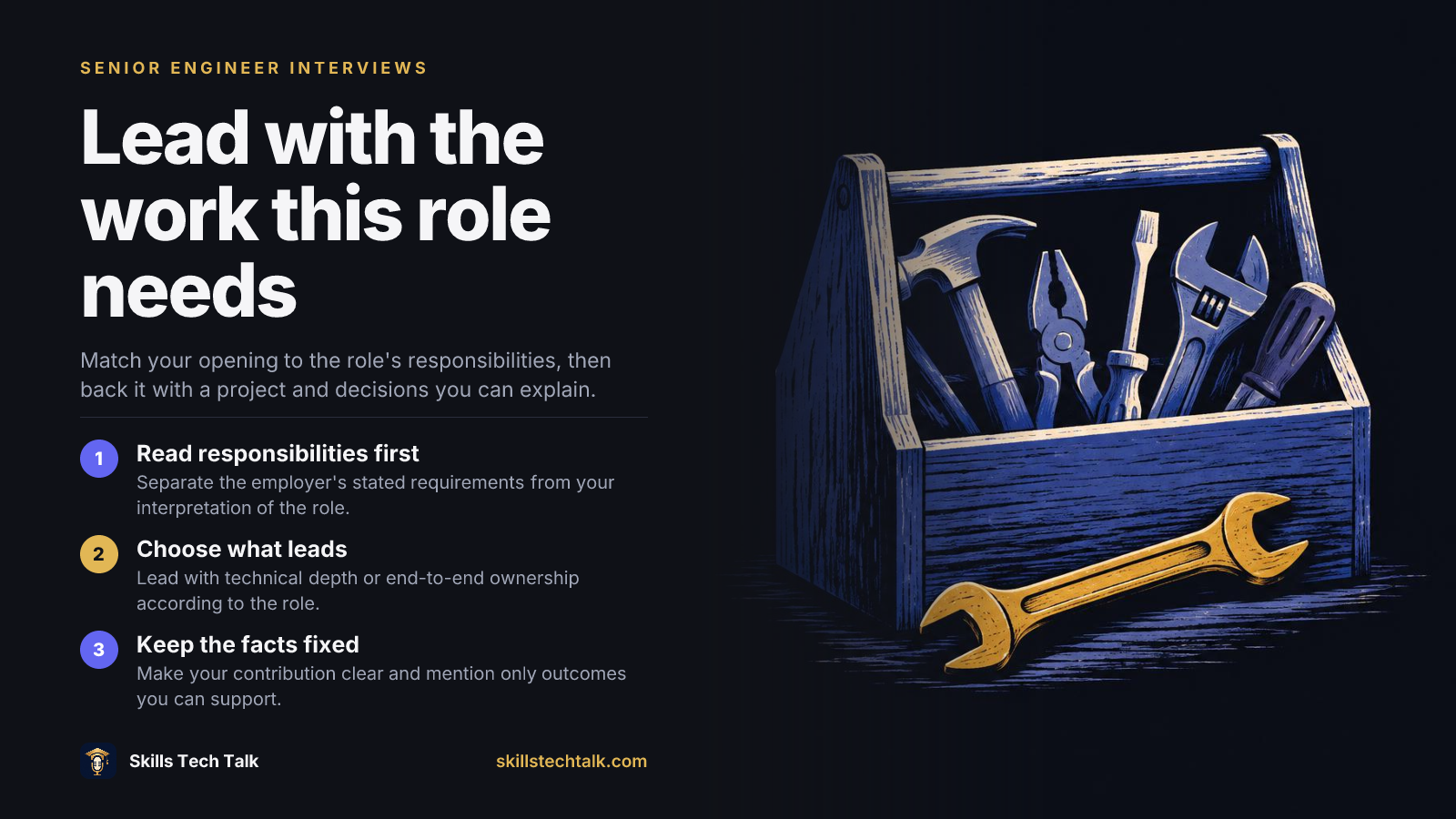
Summary slide. Match your opening to the role's responsibilities, then back it with a project and decisions you can explain. Artwork is AI-generated; every word on the slide comes from this article. Save the slide (PNG)
For senior software engineer jobs, lead with technical depth when the role calls for it, and with demonstrated end-to-end ownership when it calls for breadth. You do not need a new professional identity. You need a relevant claim backed by work you can explain.
The supplied Stack Overflow Q&A on emerging role skills challenges the idea that everyone is becoming a generalist, claiming that “that's not where headcount is going.” The excerpt provides no figures or role breakdown. It is not enough evidence to establish a hiring trend or justify abandoning a specialty.
A more useful question: What should the interviewer understand about your strengths first for this opening?
Separate depth from breadth
“Generalist” might mean exposure to many technologies or ownership of a product problem across technical boundaries. “Specialist” might mean familiarity with a tool or deep judgment about a problem such as failure recovery. The labels alone say little.
Instead, describe two dimensions:
- Depth: What difficult decisions can you defend? Be ready to explain mechanisms, alternatives, failure modes, and tradeoffs.
- Breadth: What boundaries can you work across? Show how you connected technical decisions to product requirements, infrastructure constraints, or other teams’ responsibilities.
A reliability-focused role may call for depth first and coordination evidence second. A product-oriented role may call for end-to-end ownership first, supported by technical judgment. Neither framing requires hiding the other dimension.
Build a role-fit worksheet
Start with the responsibilities, not the title. A posting describes employer expectations, but it cannot tell you how the panel will weigh every requirement. Keep the employer’s wording separate from your interpretation.
| Field | What to record | |---|---| | Explicit requirement | The employer’s wording and whether it is required or preferred | | Responsibility | The problem or work the person is expected to own | | Scope | A component, product area, or decisions spanning teams | | Required depth | Technical decisions you would need to explain | | Useful breadth | Systems, teams, or product concerns you would need to connect | | Your evidence | A project, your contribution, a tradeoff, and an outcome you can substantiate | | Gap or uncertainty | Missing experience, unclear scope, or a question for the interviewer |
Do not assume adjacent experience satisfies an explicit requirement. Describe the connection and its limits. Likewise, cross-team participation is not automatically cross-team technical leadership: identify your contribution and who held decision-making authority.
When the scope is unclear, ask: “What problem would you most want this person to take ownership of?” Treat your initial reading as a hypothesis, not a fact.
Worked example: choose the story before the label
Hypothetical scenario: A posting emphasizes service reliability, failure recovery, and coordination with infrastructure teams. Assume your experience includes designing backend recovery behavior and coordinating its rollout with product and infrastructure.
That project gives you a relevant starting point. Compare these introductions:
Before:
“I’m a generalist who can work across the stack. I’ve used several languages and enjoy learning new technologies.”
After, for a reliability-focused role:
“My strongest area is backend reliability. I can walk through a failure-recovery redesign, the recovery behavior I designed, and how I coordinated the rollout with product and infrastructure teams.”
The second version gives the interviewer a technical anchor and a concrete example of coordination. Now prepare for the follow-up: explain the failure conditions, alternatives, your design decisions, validation plan, and rollout responsibilities. Mention only outcomes you can support.
Do not add a percentage improvement to make the story sound stronger.
When a different story fits better
Now suppose the opening emphasizes customer-facing features, from requirements through release across an application stack. The recovery project may demonstrate judgment, but it does not by itself establish frontend experience or product ownership.
Assume the hypothetical candidate also has a separate project with genuine backend and frontend ownership. A better introduction for that role could be:
“My strongest fit here is owning a product change across technical boundaries. On one project, I clarified requirements with product, implemented the backend and frontend changes, and coordinated the release with infrastructure. I can explain which decisions were mine and where I relied on specialists.”
Use that version only if it is accurate. If your work was backend-only, say so. The worksheet may reveal a fit gap rather than a wording problem.
Change the emphasis, not the facts.
If interviews are not becoming offers, look beyond positioning
A clearer introduction is useful, but it cannot diagnose or fix every unsuccessful interview. Use your notes and specific feedback to choose a preparation task:
- Unclear relevance: Your opening lists technologies without naming a problem you can own. Lead with the target responsibility.
- Depth not demonstrated: Follow-up questions exposed gaps in your explanation. Practice mechanisms, alternatives, and failure modes.
- Ambiguous ownership: Your story relies on “we.” Separate your decisions from the team’s work.
- Scope mismatch: Your examples concern one service, but the role asks for decisions spanning teams. Find truthful evidence of that scope or reconsider the target.
- No useful feedback: Record the questions you found difficult. Keep the diagnosis provisional rather than attributing rejection to being a generalist or specialist.
Check your pitch before using it
- Does the opening match a stated responsibility?
- Can you explain the technical details behind the example?
- Is your personal contribution clear?
- Does your breadth show ownership or coordination, rather than exposure?
- Can you substantiate every outcome?
- Are facts, scope, and dates consistent across your resume and stories?
Apply the same emphasis to your resume: make the most relevant supported work easy to find. Your aim is a clear proposition: this is the problem I am equipped to own, and this is the evidence.
If you are interviewing but not getting offers, explore interview coaching from Skills Tech as a next step.
Save the field guide
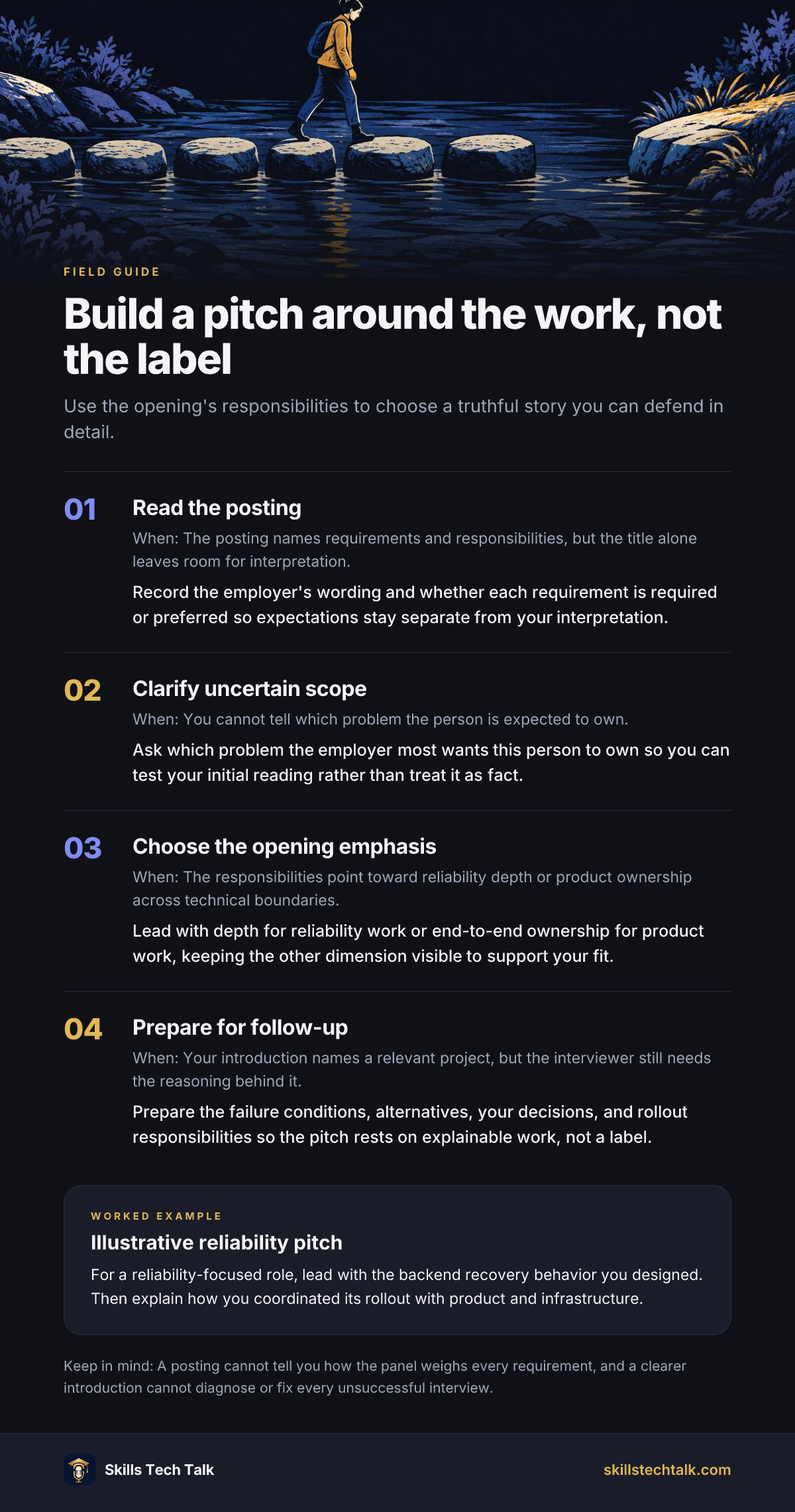
A field guide distilled from this article. The text version follows below.
Text version
- Read the posting: The posting names requirements and responsibilities, but the title alone leaves room for interpretation. Record the employer's wording and whether each requirement is required or preferred so expectations stay separate from your interpretation.
- Clarify uncertain scope: You cannot tell which problem the person is expected to own. Ask which problem the employer most wants this person to own so you can test your initial reading rather than treat it as fact.
- Choose the opening emphasis: The responsibilities point toward reliability depth or product ownership across technical boundaries. Lead with depth for reliability work or end-to-end ownership for product work, keeping the other dimension visible to support your fit.
- Prepare for follow-up: Your introduction names a relevant project, but the interviewer still needs the reasoning behind it. Prepare the failure conditions, alternatives, your decisions, and rollout responsibilities so the pitch rests on explainable work, not a label.
Illustrative reliability pitch: For a reliability-focused role, lead with the backend recovery behavior you designed. Then explain how you coordinated its rollout with product and infrastructure.
A posting cannot tell you how the panel weighs every requirement, and a clearer introduction cannot diagnose or fix every unsuccessful interview.