
Interview prep
Getting Interviews but No Offers? Diagnose What to Change
Use an interview debrief to separate role-fit problems from unclear technical reasoning, vague project stories, and mismatched seniority signals.
October 25, 2026 · 8 min read

Summary slide. Separate role fit from interview performance, then choose one observable behavior to practice. Artwork is AI-generated; every word on the slide comes from this article. Save the slide (PNG)
If you’re getting software engineering interviews but no offers, start by separating role fit from interview performance. Invitations suggest your background is generating interest. Rejections alone cannot tell you whether the issue is technical reasoning, unclear ownership, level expectations, or a hiring decision outside your control.
Rewriting your resume will not fix an unexplained design decision. More coding practice will not resolve a mismatch between the work you want and the role a team needs filled.
Before changing your whole search, identify where your evidence may be falling short of the role’s expectations. Then choose one change to evaluate in practice.
Separate what happened from what you think it means
A rejection is an outcome, not a diagnosis. Even a final-round rejection does not reveal which parts of the assessment were strong or weak.
Build a short debrief from recent interviews. Record:
- Role expectations: Advertised level, responsibilities, and anything the recruiter clarified.
- Stage reached: Recruiter conversation, coding, design, behavioral, or final discussion.
- Observable moments: Questions asked, answers given, hints received, and work left unfinished.
- Explicit feedback: Keep the employer’s wording rather than translating it into a judgment about your ability.
- Unknowns: Anything you cannot establish, including headcount decisions or other applicants’ performance.
Write “I chose a queue without explaining delivery semantics,” not “I’m bad at system design.” An observable behavior gives you something to rehearse. A judgment about your ability does not.
Choose between a targeting change and a preparation change
Use this map to form hypotheses, not conclusions. The same outcome can have several explanations.
| Pattern in your notes | Question to investigate | Useful next change | |---|---|---| | Conversations end after discussing scope or responsibilities | Are you and the employer describing the same job? | Clarify ownership and hands-on expectations before another full loop. | | Coding work stalls while you stay quiet | Is the gap implementation, problem framing, or communication? | Rehearse an unfamiliar problem while explaining assumptions, an approach, and tests. | | Design answers name components but leave decisions unexplained | Can the interviewer see why your design fits the constraints? | Compare your choice with a credible alternative. | | Project discussions prompt repeated questions about your contribution | Are you separating team results from your decisions? | Rebuild a story around ownership, alternatives, and evidence. | | Feedback mentions insufficient scope for the level | What responsibility have you not demonstrated? | Ask what scope was missing, then adjust your examples or target roles. | | Late rejections come without useful feedback | Is there enough evidence to diagnose a problem? | Request specific feedback and review observable gaps without inventing a cause. |
One interview is not proof of a recurring weakness. Look for repeated behavior across debriefs, explicit feedback, and focused practice.
Make tradeoffs visible
A technically reasonable answer can still leave your judgment unclear. If you jump straight to a database, queue, or service boundary, the interviewer has to infer why you chose it.
Use this structure:
Given this constraint, I would choose this approach over that alternative. It improves this property but introduces this cost. I would revisit the decision if this assumption changed.
Worked example: designing a notification service
Hypothetical assumptions: The service sends email notifications. Requests should return before delivery finishes. Failed deliveries can be retried, but duplicate messages are undesirable. Traffic volume and delivery-time targets are unspecified.
A thin answer:
“I’d put requests on a queue and have workers send the emails.”
A more assessable answer:
“I’d separate accepting a notification from delivering it because the request should not wait for the email provider. A durable queue could let workers retry transient failures, but retries introduce a duplicate-delivery risk. I’d give each notification a stable identifier and track delivery attempts. I’d also ask whether the provider supports idempotency, because a timeout after a successful send can leave us unsure whether retrying will send another email. Without that support, I would not claim exactly-once delivery. Before choosing capacity or partitioning, I’d clarify expected traffic and acceptable delay.”
The difference is the reasoning, not the number of components. The second answer connects a choice to a requirement, exposes a failure mode, and identifies missing information.
In coding interviews, apply the same principle: explain the constraint, choose an approach, state its cost, and test boundary cases. You do not need to narrate every keystroke. Make consequential decisions audible.
Replace vague stories with clear ownership
“We migrated the platform and improved reliability” describes a team accomplishment. It does not show what you contributed.
For each project story, prepare an ownership spine:
- Problem: What was failing, blocked, or becoming difficult?
- Responsibility: What were you accountable for, and what belonged to others?
- Decision: Which meaningful choice did you make or influence?
- Alternative: What other approach was credible, and why did you reject it?
- Evidence: What actually happened, and how do you know?
- Reflection: What limitation remained, or what would you change?
In a hypothetical migration story, distinguish the team’s implementation work from your responsibility for the rollout plan. Why choose an incremental rollout over a single cutover? What would trigger a rollback? Who disagreed, and how was that resolved?
Use real outcomes. If you lack reliable metrics, say so. A verified operational change or completed migration can be evidence without an invented percentage improvement. Be clear when results were mixed.
Match your evidence to the role
Senior and staff titles do not fully describe a job. Ask about responsibilities:
- What would this person own directly?
- Which decisions would they make independently?
- Where would they need to influence other teams?
- How much implementation work is expected?
- What would successful work look like in the initial period?
Choose stories that demonstrate that scope. A story about individual implementation may leave a cross-team coordination requirement unanswered. An answer about organizational direction may omit the technical depth needed for a hands-on role.
Do not inflate your ownership to bridge a mismatch. Choose a better example, explain the boundary honestly, or reconsider the role.
Close with a synthesis, not a sales pitch
A useful close cannot rescue missing technical evidence. It can summarize your reasoning or invite clarification.
At the end of a design discussion:
“This design separates accepting requests from delivery and allows retries after transient failures. Before finalizing it, I’d clarify how to handle possible duplicate sends and what delivery delay is acceptable.”
At the end of a role conversation:
“Is there an area of the role’s scope that I haven’t given you enough evidence about?”
The interviewer may not provide feedback. Invite clarification, not a positive verdict.
Run one focused practice cycle
Before your next interview, complete this debrief card:
Observed moment: What exactly happened?
Role requirement: What was the interviewer trying to assess, as far as I can establish?
Working hypothesis: What was missing from my answer?
Alternative explanation: What else could explain the outcome?
Practice task: What specific answer or behavior will I rehearse?
Success criterion: What should a listener be able to explain back to me?
For the notification example, success might mean: “A listener can explain why I chose asynchronous delivery, what duplicate risk remains, and which missing requirement could change the design.”
Rehearse with a colleague. Ask them to summarize your reasoning before giving advice. If they cannot identify your decision and its downside, revise the explanation. If they can, examine whether the decision itself holds up.
That separates clarity from correctness. Neither guarantees an offer, but both give you a specific preparation task instead of a reason to rebuild your search after every rejection.
If you want help identifying what to practice next, explore Interview Coaching from Skills Tech.
Save the field guide
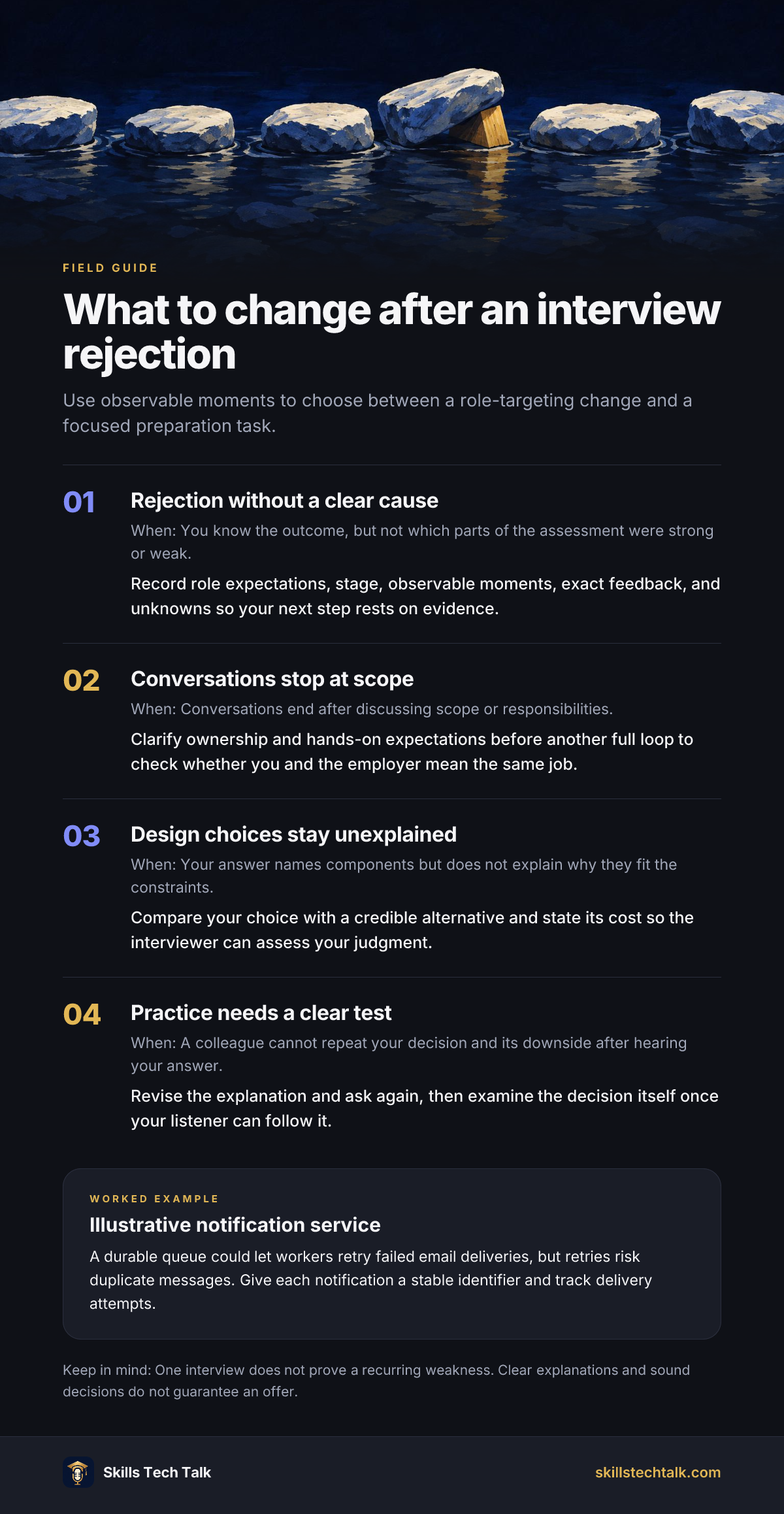
A field guide distilled from this article. The text version follows below.
Text version
- Rejection without a clear cause: You know the outcome, but not which parts of the assessment were strong or weak. Record role expectations, stage, observable moments, exact feedback, and unknowns so your next step rests on evidence.
- Conversations stop at scope: Conversations end after discussing scope or responsibilities. Clarify ownership and hands-on expectations before another full loop to check whether you and the employer mean the same job.
- Design choices stay unexplained: Your answer names components but does not explain why they fit the constraints. Compare your choice with a credible alternative and state its cost so the interviewer can assess your judgment.
- Practice needs a clear test: A colleague cannot repeat your decision and its downside after hearing your answer. Revise the explanation and ask again, then examine the decision itself once your listener can follow it.
Illustrative notification service: A durable queue could let workers retry failed email deliveries, but retries risk duplicate messages. Give each notification a stable identifier and track delivery attempts.
One interview does not prove a recurring weakness. Clear explanations and sound decisions do not guarantee an offer.