
Interview prep
Before Your Next Senior Engineer Interview, Verify the Role
Use five recruiter questions and a Role Readiness Worksheet to decide where targeted interview preparation is justified and where clarification should come first.
November 1, 2026 · 8 min read

Summary slide. Clarify approval, ownership, scope, and the next decision before committing substantial role-specific preparation. Save the slide (PNG)
Consider this hypothetical choice: you have six preparation hours before two interview loops, and one recruiter confirms approved replacement headcount, a named manager, and a defined interview sequence. The other opportunity involves a possible new team whose responsibilities are still being discussed, with approval status unanswered.
I would spend more role-specific preparation on the first opportunity while keeping transferable preparation active. That is not a judgment about which company is better. It is a decision about where preparation has a clearer purpose.
For Role A, the next interview will assess system design and technical leadership. An advancement decision is expected afterward, but the response date is only an estimate. For Role B, a meeting with an engineering leader is confirmed, but the scope could involve either individual contribution or team leadership.
One illustrative allocation would be:
- Three hours for Role A: Practice a relevant design discussion and select examples of technical decisions, trade-offs, and collaboration.
- Two hours for transferable preparation: Review a difficult project and practice explaining your own contribution clearly.
- One hour for Role B: Review the supplied material and prepare questions about ownership and scope, rather than building a detailed presentation for an undefined responsibility.
These hours are an example, not a recommended ratio. If Role B clarifies its scope, the allocation can change.
An interview invitation creates an opportunity to demonstrate your skills. It does not establish how ready the employer is to hire.
Delay narrowly targeted work when the target is still unclear.
Ask five questions before committing substantial preparation time
Frame these questions as a way to prepare effectively and coordinate your search, not as a demand for internal documents. A recruiter may need to check with the hiring manager. That is a reasonable answer.
1. Is the headcount approved for hiring now?
“To help me plan the process, is this position approved for hiring now, or is any budget or headcount approval still pending? If approval is pending, what must happen next, and when do you expect to revisit it?”
Distinguish an authorized opening from one dependent on another decision; neither predicts an offer, and an expected approval date remains an estimate unless it is a firm milestone.
2. Is this a replacement or a new position?
“Is this a replacement role or a new position, and what work would you want this person to take ownership of?”
Judge the explanation of responsibilities, boundaries, and reasons for hiring, not the label: a replacement can have unclear expectations, while a new position can have a defined purpose.
3. Who owns the hire and the final decision?
“Who would manage this person, and how is the final hiring decision made after the interviews? If the reporting line is unsettled, will it be resolved before the next round?”
Look for an identifiable owner and an understandable decision path, not every approver’s name; an unsettled reporting line matters because managers may expect different senior-level contributions.
4. Which parts of the role are settled, and which are still open?
“Which parts of the scope and level are already agreed, and which are you still shaping? What should I prepare to demonstrate in the next round?”
Some flexibility is compatible with a real hiring need; seek clarification when it obscures the evaluation, since hands-on delivery and cross-team technical direction call for different examples.
5. What is the next decision milestone?
“After the next conversation, what decision will the team be making, and when should I expect an update? Are there dependencies that could change that timing?”
Look for what the meeting should resolve, such as advancement, role scope, or final selection, and record estimated timing as an estimate rather than a commitment.
Save a Role Readiness Worksheet
For each opportunity, keep three kinds of information separate:
- Confirmed facts: Explicit answers, with who provided them and when. These are reported confirmations, not independent verification.
- Recruiter estimates: Expectations about timing, scope, or decisions that are not settled.
- Unanswered questions: Missing information, plus who will clarify it and at what point.
Use this template after a recruiter screen. The first row is an illustrative example showing how one conversation can produce all three kinds of information; replace it with your own notes.
| Signal | Confirmed facts | Estimates | Unanswered question or follow-up | |---|---|---|---| | Illustrative opportunity summary | Recruiter reported approved headcount during today’s screen. | Recruiter expects an advancement decision next week. | Hands-on ownership or cross-team direction? Recruiter will ask the hiring manager before the next round. | | Headcount approval | | | | | Reason for opening | | | | | Hiring ownership | | | | | Scope and level | | | | | Next decision milestone | | | |
Keep the wording precise. “Recruiter said approval is expected” belongs under estimates, not confirmed facts. “No answer yet” belongs under unanswered questions, not evidence that the position is fake.
Uncertainty is a planning input, not proof of bad faith.
The worksheet prevents an encouraging conversation from becoming a stronger claim in your notes than anyone actually made.
Turn the answers into one of three preparation choices
| Choice | When it fits | What to do | |---|---|---| | Commit preparation time | Approval is reported as confirmed, with a clear owner, defined work, and an understandable path to a hiring decision. | Prepare examples and technical material matched to the stated evaluation. Keep other opportunities active. | | Request clarification first | An unresolved issue would materially change preparation, or approval is pending with a clear checkpoint. | Ask before starting substantial role-specific work. If scope and evaluation are clear but approval is pending, keep targeted preparation limited until the checkpoint. Continue transferable preparation. | | Keep the conversation warm | Progress depends on unresolved approval, ownership, or team decisions without a clear checkpoint. | Seek a follow-up milestone and prioritize opportunities with clearer next steps. |
Pending approval with a checkpoint is different from pending approval without one. But a checkpoint is not approval: if the evaluation target is also unclear, narrowly targeted work should wait.
These are resource-allocation choices, not ratings of employer honesty. You might reasonably explore an ambiguous role because the work interests you. Make that trade-off deliberately.
Keep employer readiness separate from interview performance
Role verification cannot explain every rejection or stalled process. Approved headcount and a clear hiring manager do not establish that your performance met the employer’s criteria.
Keep two separate review tracks:
| Employer readiness | Candidate performance | |---|---| | Was the role approved and defined? | Did I answer the question asked? | | Was there an identifiable decision owner? | Did I explain my contribution and trade-offs? | | Did the stated milestone occur? | Did I demonstrate the scope expected at this level? |
Both tracks can contain problems at once. Do not let an unclear process excuse an answer you know was weak, or let a stalled process become proof that your skills are inadequate.
A clear role can still end in rejection.
Resource note: For the candidate-performance side, explore Skills Tech for engineers interviewing but not yet receiving offers.
Try a five-minute review before your next screen
Choose one active opportunity and fill in the worksheet using only information you already have. Mark each item as confirmed, estimated, or unanswered. Then send the single clarification that would most change your preparation plan.
For example:
“Before I prepare for the next round, could you confirm whether the role is focused on hands-on ownership of one service or technical direction across teams? That will help me choose the most relevant examples.”
This exercise will not reveal every internal dependency or predict an offer. It will give you a better basis for deciding what to prepare now, what to clarify, and what can wait.
Save the field guide
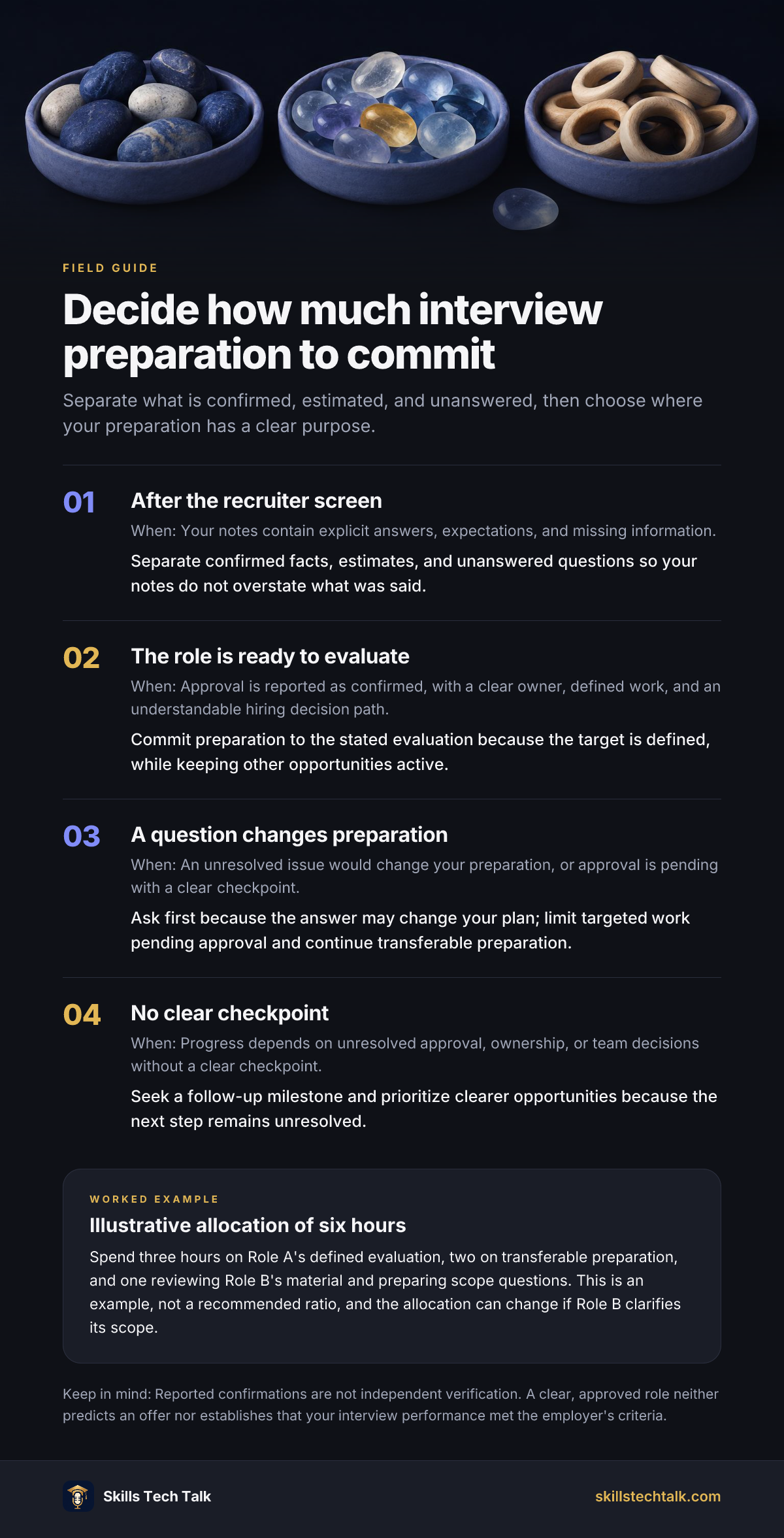
A field guide distilled from this article. The text version follows below.
Text version
- After the recruiter screen: Your notes contain explicit answers, expectations, and missing information. Separate confirmed facts, estimates, and unanswered questions so your notes do not overstate what was said.
- The role is ready to evaluate: Approval is reported as confirmed, with a clear owner, defined work, and an understandable hiring decision path. Commit preparation to the stated evaluation because the target is defined, while keeping other opportunities active.
- A question changes preparation: An unresolved issue would change your preparation, or approval is pending with a clear checkpoint. Ask first because the answer may change your plan; limit targeted work pending approval and continue transferable preparation.
- No clear checkpoint: Progress depends on unresolved approval, ownership, or team decisions without a clear checkpoint. Seek a follow-up milestone and prioritize clearer opportunities because the next step remains unresolved.
Illustrative allocation of six hours: Spend three hours on Role A's defined evaluation, two on transferable preparation, and one reviewing Role B's material and preparing scope questions. This is an example, not a recommended ratio, and the allocation can change if Role B clarifies its scope.
Reported confirmations are not independent verification. A clear, approved role neither predicts an offer nor establishes that your interview performance met the employer's criteria.