
Interview prep
Turn Vague Interview Rejection Feedback Into a Practice Plan
Learn what vague interview rejection feedback can tell you, how to ask for specifics, and how to choose a focused practice exercise.
October 29, 2026 · 7 min read
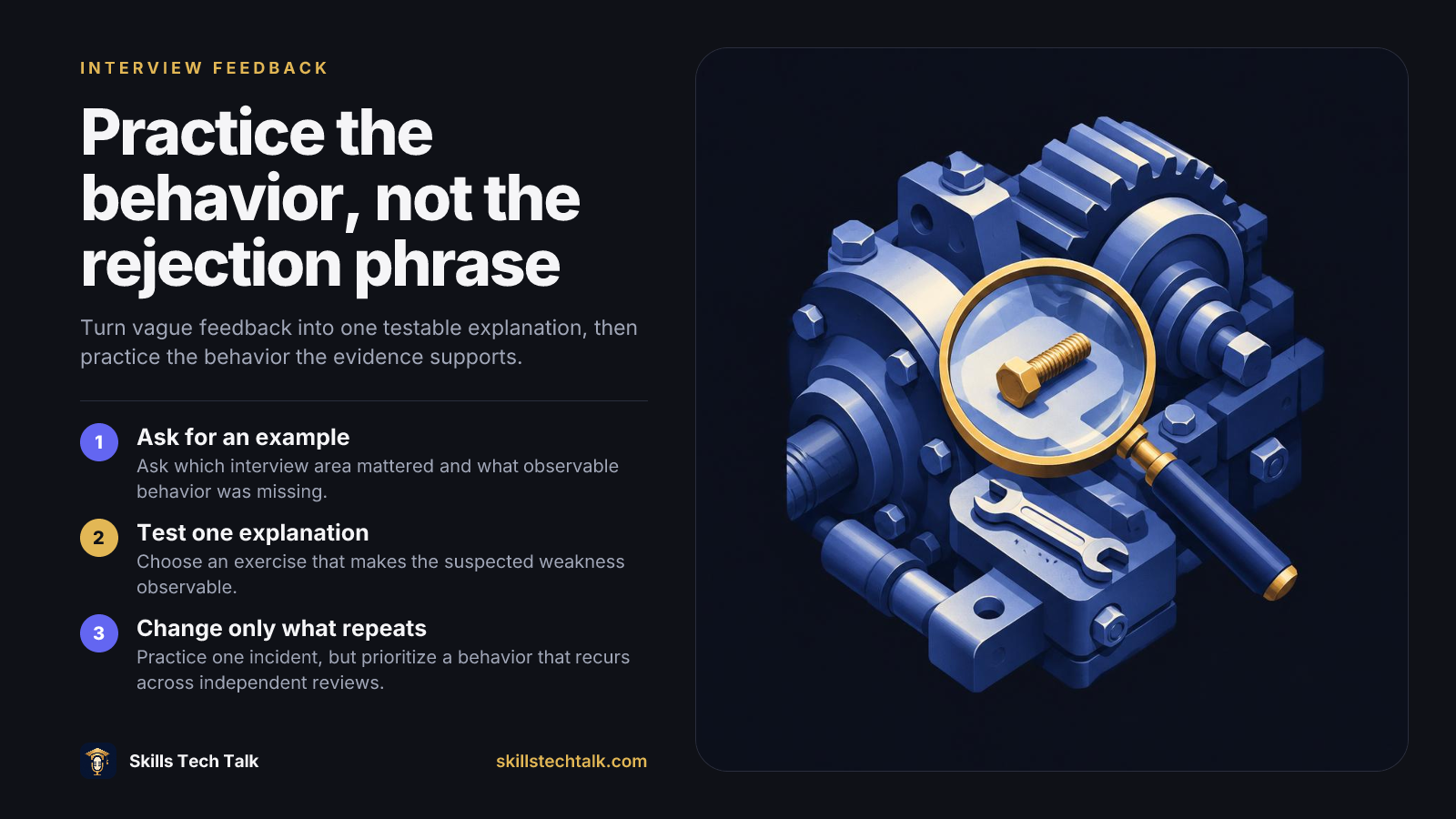
Summary slide. Turn vague feedback into one testable explanation, then practice the behavior the evidence supports. Save the slide (PNG)
Illustrative example: After a senior engineer interview, you hear, “We wanted more technical depth.” Studying database internals might help, but not if the missing evidence was your explanation of why a queue fit the workload or how it would handle failures.
The rejection gives you something to investigate, not a diagnosis of your ability. Your next decision is which observable behavior to test before the next interview.
Treat rejection phrases as hypotheses, not diagnoses
“Not a good fit” has no dependable translation. Without an example, you cannot tell whether it refers to technical performance, role scope, collaboration, domain experience, or a comparison with another candidate.
A rejection is an outcome, not a diagnosis.
Use this table to generate questions, not conclusions. These are possible interpretations, not claims about what employers usually mean.
| Feedback phrase | What remains unresolved | A useful behavior to examine | |---|---|---| | “We chose someone who was a better fit.” | Which requirement distinguished the candidates, if any? | Could an interviewer connect your examples to the role’s responsibilities? | | “We wanted more technical depth.” | Was knowledge missing, or was your reasoning insufficiently demonstrated? | Did you explain assumptions, alternatives, failure modes, and constraints? | | “We needed stronger communication.” | Was the issue structure, clarity, listening, or something else? | Did you answer directly, clarify ambiguity, and respond to interruptions? | | “We wanted more senior-level impact.” | Was the concern scope, ownership, judgment, or evidence of results? | Could the listener distinguish your decisions from the team’s work? | | “Your coding performance did not meet the bar.” | Was the gap correctness, progress, testing, or explanation? | Where did your solution become incorrect, stall, or require a hint? |
Specific feedback narrows the question. “You did not discuss recovery after a worker failure” identifies a missing behavior. It does not prove you lack distributed systems knowledge.
I would change preparation based on a concrete example or a weakness that appears again in practice. I would not overhaul it based on “fit” alone.
Ask for an observation, not a verdict
A broad request such as “Do you have any feedback?” leaves the recipient to decide what to share. Give them a narrower question, while respecting that details may be unavailable:
Thank you for letting me know and for the team’s time. I’m working on improving my interview performance. If you’re able to share, which interview area most affected the decision, and was there one observable example of what was missing? I understand if detailed feedback is unavailable.
If they have already named an area, build on it:
Thank you for the feedback about technical depth. Was the concern primarily about my design choices or how I explained their trade-offs? One example would help me focus my preparation.
Keep the request separate from an appeal. Explaining everything you meant to say does not establish what the interviewer observed.
One concise follow-up is a reasonable boundary. If the company declines or does not respond, seek another source of evidence. Silence does not tell you what went wrong.
Use an Evidence-to-Action card
Before your next practice session, write four short entries. Keep the feedback separate from your interpretation.
1. Observation
Record the exact feedback and a specific interview event you remember:
- Feedback: “We wanted more technical depth.”
- My recollection: “I selected a queue but did not explain retries or duplicate processing.”
Your recollection is not the interviewer’s assessment. Mark uncertain details rather than filling them in.
2. Hypothesis
Choose one explanation you can test. For example: “I state design choices without explaining how they behave under failure.”
Avoid identity judgments such as “I’m not senior enough.” They offer neither a practice task nor a stopping point.
3. Test
Choose an exercise that exposes the suspected behavior. For this example, explain a background-job design to an experienced engineer. Ask them to probe what happens when a worker crashes, a job arrives twice, or a dependency stays unavailable.
4. Success criterion
Define what the reviewer should observe:
For each major design choice, I can state the relevant constraint, explain a failure case, and justify a recovery approach.
Practice the missing behavior, not the rejection phrase.
If the exercise does not reveal the suspected weakness, reconsider the hypothesis. One successful attempt does not rule it out, but neither should you force the evidence to fit.
Use mock interviews to test the hypothesis
A mock interview with an experienced engineer can provide another observation when an employer will not give details. It cannot reveal a hiring committee’s private reasoning or reproduce every company’s criteria.
Choose someone who can evaluate the relevant work: coding, system design, or senior-level behavioral examples. Share a small rubric before the session, but save your suspected weakness for afterward. This can help avoid steering the review toward your explanation.
For a system design mock, use these four signals:
- Problem framing: Did you establish requirements and constraints?
- Decision reasoning: Did you connect choices to those constraints?
- Failure analysis: Did you explain what breaks and how the system responds?
- Interaction: Did you incorporate new information and interviewer prompts?
Ask the reviewer to distinguish what you volunteered from what appeared only after prompting. Both matter, but they are different evidence.
Afterward, ask:
Where did my answer stop giving you enough evidence to evaluate my judgment? Please point to a specific moment and describe what you needed next.
Then repeat that segment. If the issue was unexplained trade-offs, retry the decision explanation before scheduling another full mock.
A mock can expose a practice target. It cannot establish why a company rejected you.
Change only what the evidence supports
Match the size of the preparation change to the evidence:
- Only generic feedback: Keep your preparation priorities and seek an observable assessment.
- One concrete incident: Practice that behavior and check whether it recurs.
- The same behavior across independent reviews: Make it a preparation priority.
- Feedback about role scope rather than execution: Review targeting too. Prepare examples that match the responsibilities, or consider roles better aligned with your experience.
Getting interviews but not offers does not establish a single cause. You do not yet have evidence that every part of your search needs rebuilding.
Try a five-minute rejection review
Take your most recent rejection and fill in one Evidence-to-Action card: quote the feedback, record one remembered event, write one testable hypothesis, and choose an observable success criterion.
If you cannot identify an event, write “unknown.” Gather evidence rather than inventing an explanation.
This exercise will not recover the employer’s reasoning. It gives you a bounded next step instead of an unfocused study plan.
For support turning that target into a practice session, explore Interview Coaching from Skills Tech.
Save the field guide
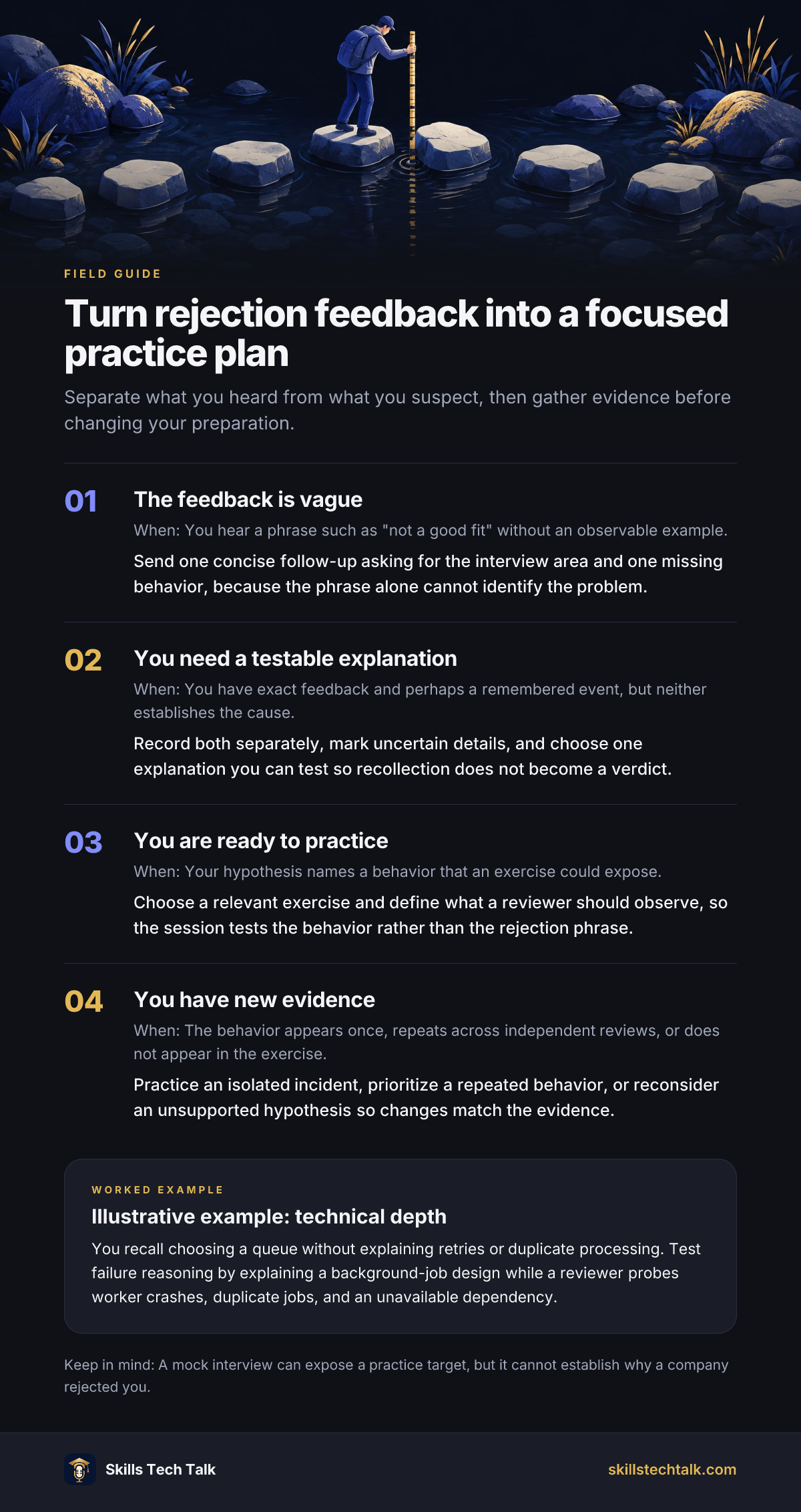
A field guide distilled from this article. The text version follows below.
Text version
- The feedback is vague: You hear a phrase such as "not a good fit" without an observable example. Send one concise follow-up asking for the interview area and one missing behavior, because the phrase alone cannot identify the problem.
- You need a testable explanation: You have exact feedback and perhaps a remembered event, but neither establishes the cause. Record both separately, mark uncertain details, and choose one explanation you can test so recollection does not become a verdict.
- You are ready to practice: Your hypothesis names a behavior that an exercise could expose. Choose a relevant exercise and define what a reviewer should observe, so the session tests the behavior rather than the rejection phrase.
- You have new evidence: The behavior appears once, repeats across independent reviews, or does not appear in the exercise. Practice an isolated incident, prioritize a repeated behavior, or reconsider an unsupported hypothesis so changes match the evidence.
Illustrative example: technical depth: You recall choosing a queue without explaining retries or duplicate processing. Test failure reasoning by explaining a background-job design while a reviewer probes worker crashes, duplicate jobs, and an unavailable dependency.
A mock interview can expose a practice target, but it cannot establish why a company rejected you.